By: Will Martinez ……..
In the realm of cult cinema, few films have achieved the enigmatic and lasting allure of “Donnie Darko.” Directed by Richard Kelly and released in 2001, this mind-bending masterpiece defies easy categorization, blending elements of science fiction, psychological thriller, and coming-of-age drama into a thought-provoking and visually mesmerizing narrative. “Donnie Darko” is a film that has continued to captivate and confound audiences for over two decades, inviting viewers to delve deep into its intricate web of mysteries, metaphysics, and human existence.
The story of “Donnie Darko” unfolds in the quiet suburban town of Middlesex, where we are introduced to the eponymous protagonist, Donnie (played by a young Jake Gyllenhaal). A troubled teenager, Donnie grapples with a variety of personal issues, from mental illness to existential angst, all while navigating the trials and tribulations of high school life. However, Donnie’s world takes a bizarre turn when he narrowly escapes death one fateful night, thanks to a mysterious force that compels him out of bed.
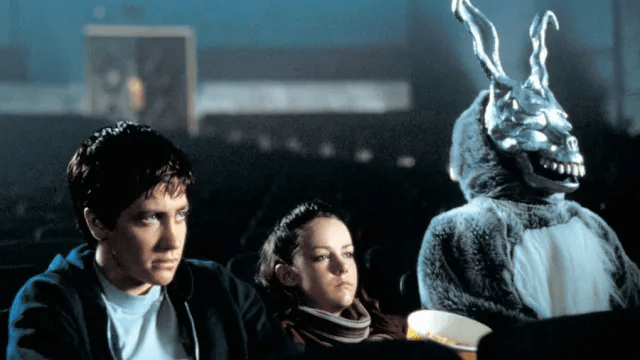
As the film progresses, Donnie becomes increasingly entangled in a series of perplexing events, including encounters with a grotesque, time-traveling rabbit figure known as Frank (played by James Duval), who serves as a harbinger of doom. Frank’s cryptic messages and Donnie’s subsequent visions lead him on a journey to uncover the hidden truths about the universe, time travel, and his own existence.

At its core, “Donnie Darko” is a meditation on isolation, mental illness, and the inherent search for meaning in an often confusing and arbitrary world. Donnie’s struggles with his own psychological well-being mirror his quest for understanding in a universe that seems devoid of logic. His isolation is palpable, a reflection of the alienation many teenagers experience as they navigate the turbulent waters of adolescence.
Existential themes also permeate the film, as Donnie grapples with questions of free will, determinism, and the nature of reality itself. The concept of time travel, introduced through the film’s intricate plot, serves as a metaphor for the human desire to escape the constraints of fate and rewrite our destinies. As Donnie explores the possibility of altering the course of history, he ultimately confronts the inescapable truth that some events are preordained, and one’s choices may have far-reaching consequences.
Beyond its captivating narrative, “Donnie Darko” is renowned for its striking visual and auditory elements. Cinematographer Steven Poster’s masterful use of dark, atmospheric lighting creates a sense of foreboding, while the film’s haunting, melancholic score by Michael Andrews enhances the emotional depth of each scene. Together, these elements create an immersive experience that draws viewers into Donnie’s world, blurring the lines between reality and illusion.

Upon its initial release, “Donnie Darko” struggled to find mainstream success, earning modest box office returns. However, the film’s complex themes and unconventional storytelling quickly resonated with a devoted fanbase, propelling it to cult status. Over the years, “Donnie Darko” has inspired countless discussions, fan theories, and midnight screenings, cementing its reputation as a cult classic.
“Donnie Darko” is a cinematic gem that defies easy explanation and demands repeated viewings to unravel its intricate layers. Richard Kelly’s masterful direction, combined with standout performances by the cast, especially Jake Gyllenhaal, ensures the film’s lasting impact. Through its exploration of mental illness, existentialism, and the mysteries of time, “Donnie Darko” invites viewers to ponder the complexities of human existence and the enigmatic forces that shape our lives. As we continue to grapple with the unanswered questions posed by this cult classic, it remains a testament to the enduring power of independent cinema to challenge, provoke, and inspire.

 Dark Fringe Radio